Smart materials & tribology
Adaptive-Traction MREs
A smart material whose grip increases on command — the magnetic field that activates it is switched by the weight of each step, with no batteries or electronics. Starting with a retrofittable cane tip.
Status: validated material + custom test rigThe problem
Adults 65 and older report roughly 36 million falls each year in the U.S. alone. Nearly 47,000 older adults are treated in emergency departments annually for falls associated with the walking aids meant to prevent them, and about 500,000 people are treated for ladder-related injuries every year. The common failure point is friction: rubber cane tips, crutch tips, ladder feet, and shoe soles are fixed, passive materials. The same tip treats a wet floor, a dusty construction site, and an icy sidewalk exactly the same way — nothing adapts in real time.
Sources: CDC MMWR (2020); Stevens et al., J Am Geriatr Soc (2009); American Ladder Institute. Falls are the leading cause of injury death among seniors.
How it works
Magnetorheological elastomers (MREs) are smart materials whose friction increases under a magnetic field. We 3D-print micron-scale carbonyl-iron particles into a flexible elastomer with a magnet beneath the build plate, aligning the particles into internal columnar structures as the material cures. Field on, grip rises; field off, it releases. In our proof-of-concept cane tip, the switching is purely mechanical: the downward force of a step rotates a compact magnetic switch on, and a spring resets it off when the cane lifts — no batteries, no electronics, nothing for the user to remember.
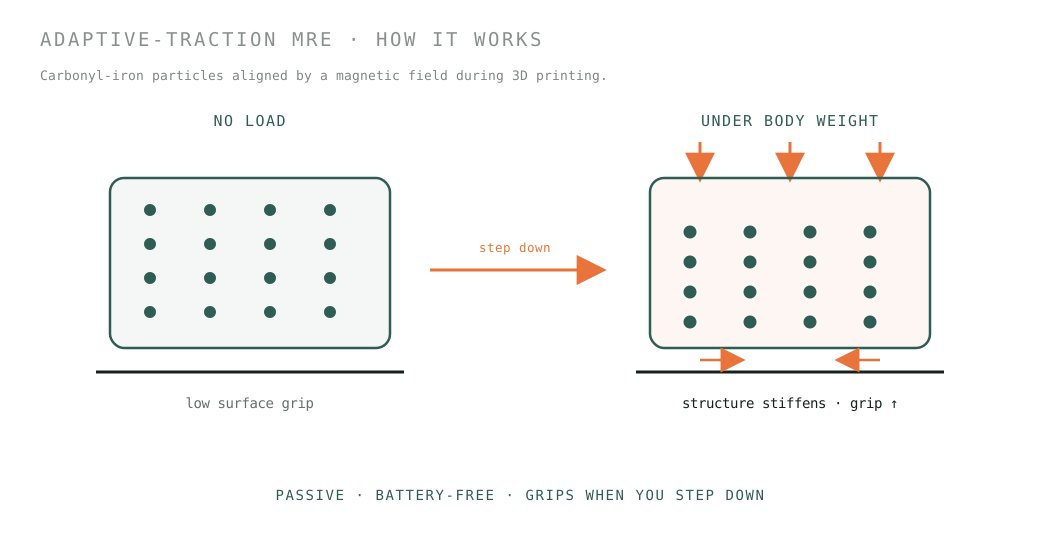
Weight-activated switching
The step's own force rotates a compact magnetic switch on, and a spring resets it on lift — eliminating the batteries, electronics, and miniaturized electromagnetic activator that industry cites as the main barrier to commercializing MREs.
Measured formulation optimum
Across 273 in-house trials spanning 30 conditions, a 10%-iron-by-weight formulation gave +78.6% mean friction force over the no-iron control and the most consistent grip across dry, dusty, and wet surfaces — with a novel reversal of the magnetic effect above ~9.8% iron.
Built-from-scratch testing
With no lab tribometer available, the friction-testing rig was built from a deconstructed 3D printer, instrumented with a load cell and an IMU to detect the exact moment static friction breaks.
The process
How it was built
BUILD LOG — FORMULATIONS TESTED
Carbonyl-iron concentrations of 0%, 4%, 8%, 10%, and 12% by weight were printed and tested on a custom friction rig across dry, dusty, and wet surfaces with the field on and off. 10% Fe was the measured optimum — the most consistent grip across all surfaces under activation; above ~9.8% the magnetic effect reverses.
- MATERIAL
- Carbonyl iron (3–5 µm) in UV resin
- ALIGNMENT
- Magnetic field during print
- TEST RIG
- built from a 3D printer
- ANALYSIS
- 273 trials · 30 conditions
- STATUS
- measured · pending lab x-val
Where it stands
The friction results are measured and statistically significant — but they currently rest on a test rig built in-house. We treat them as promising in-house findings pending independent validation, not finished claims. The most credible next step is cross-validating the friction data — including the ~9.8% reversal threshold — against a calibrated laboratory tribometer.
The first application is a working proof-of-concept cane tip: pressing down activates the field and lifts release it, with no user intervention. Because the tip is estimated to cost under $2 to manufacture, it can retrofit the canes, crutches, and ladders people already own — with footwear and industrial safety surfaces on the same material platform.
What’s next
- Independent cross-validation of the friction data — wet surfaces and the reversal threshold — against a calibrated lab tribometer.
- Durability and real-world-surface testing of the cane-tip prototype on tile, concrete, and linoleum.
- Customer-discovery interviews with clinicians and walking-aid users to document demand.
- An NSF SBIR/STTR Project Pitch leading to a Phase I proposal, partnered with a university mechanical-engineering lab.
Research prototype
This is an early-stage research prototype developed for engineering study and grant applications. It is not available for sale, has not been cleared or approved by the FDA, and performance results to date are from in-house testing pending independent validation. Nothing here is medical advice. Friction figures cited here are in-house measurements from a custom-built rig, pending independent laboratory cross-validation.