Mobility & fall prevention · Assistive robotics
OmniWheel Walker
A retrofittable smart walker that moves in every direction and watches out for the user — turning a passive frame into an active fall-prevention system.
Status: working integrated prototypeThe problem
The walker hasn’t fundamentally changed in decades, and its most dangerous moments hide in plain sight. To turn or step sideways, a user has to lift the walker and reposition it — and that lift is exactly when balance is lost. Add an unseen obstacle, like a rug edge or a cord, and you have the recipe for a fall.
Falls are the leading cause of injury death for adults over 65. A standard walker is a passive aid — it does nothing to prevent the fall it’s meant to guard against.
What we built
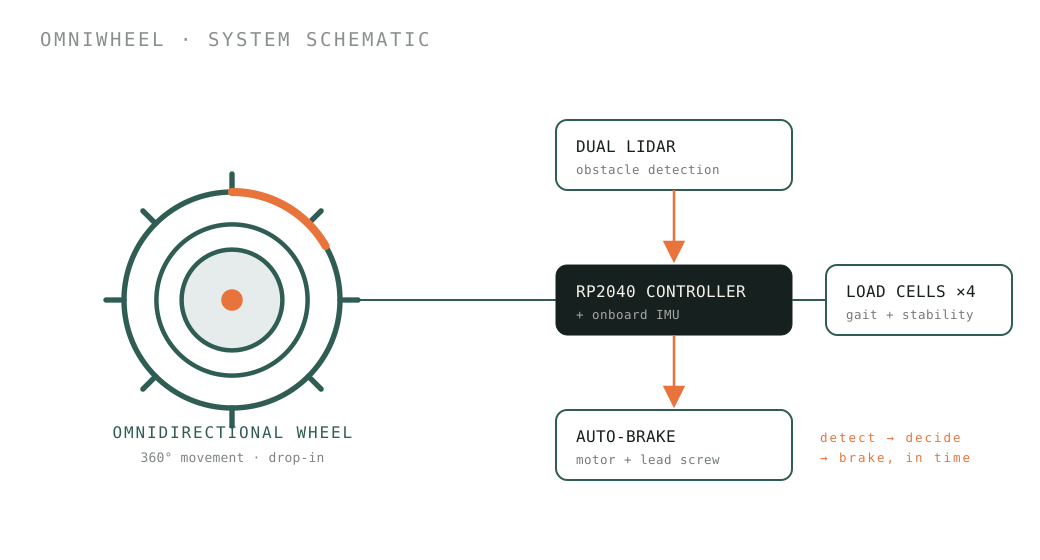
A walker that moves in every direction and watches out for its user. At the base is a “Bell-and-Cup” omnidirectional wheel that gives the walker true 360° movement, so there’s no more lifting to turn. Layered on top are three integrated sensing-and-control subsystems — all designed, built, and integrated into a single working prototype.
Bell-and-Cup omni wheel
A 360°-capable wheel — iterated across many 3D-printed versions — that drops into a standard walker in place of fixed, forward-only wheels, removing the lift-and-reposition maneuver that causes many walker falls.
Gait & stability sensing
Load cells embedded in all four legs continuously track weight distribution and gait as a proxy for user stability.
Lidar obstacle detection
Two downward-angled lidar sensors scan the floor ahead for obstacles — from cords to thresholds to clothing.
Automatic braking
A motor-driven lead screw gently engages the omni wheel when an obstacle is detected, stopping the walker before the user does.
Built around an Arduino RP2040 controller with an onboard IMU, four-leg load cells, dual lidar, and a braking motor and lead screw — the entire braking assembly hides inside the walker’s front legs.
The process
How it was built
BUILD LOG — WHEEL ITERATIONS
The Bell-and-Cup wheel went through many printed revisions — early versions let the ball rub or pop out of the cup; later ones added grooved bearings and a two-material enclosure for smooth, secure 360° movement.
- CONTROLLER
- Arduino RP2040 + IMU
- SENSING
- 4× leg load cell · 2× lidar
- BRAKE
- motor-driven lead screw
- WHEEL
- Bell-and-Cup, 3D-printed
- STATUS
- working prototype · in-house
Where it stands
All four capabilities — omnidirectional movement, gait/stability sensing, lidar detection, and automatic braking — work together in today’s prototype. The stability and obstacle-response benefits have been demonstrated in-house; they have not yet been independently validated, and we make no clinical efficacy claims.
The technical research question we want to answer next is a real one: fusing continuous gait sensing with automatic braking on an omnidirectional platform — detecting a fall-risk moment and responding safely, in time.
What’s next
- Independent gait- and motion-lab testing comparing the OmniWheel walker to a standard walker across turning, lateral movement, and obstacle response.
- Reliability and safety testing of the sensing and automatic-braking subsystem.
- Customer-discovery interviews with physical therapists, geriatric clinicians, and assisted-living staff to document real-world need.
- An SBIR/STTR proposal to the NIH National Institute on Aging, with a university gait/rehabilitation-engineering partner.
Research prototype
This is an early-stage research prototype developed for engineering study and grant applications. It is not available for sale, has not been cleared or approved by the FDA, and performance results to date are from in-house testing pending independent validation. Nothing here is medical advice. Fall-related statistics on this page are drawn from public CDC and peer-reviewed sources and describe the problem, not this device.